
Dental implants
We replace missing teeth with titanium implants, so you can bite and smile with confidence again. Computer-guided implant dentistry, including immediate loading.
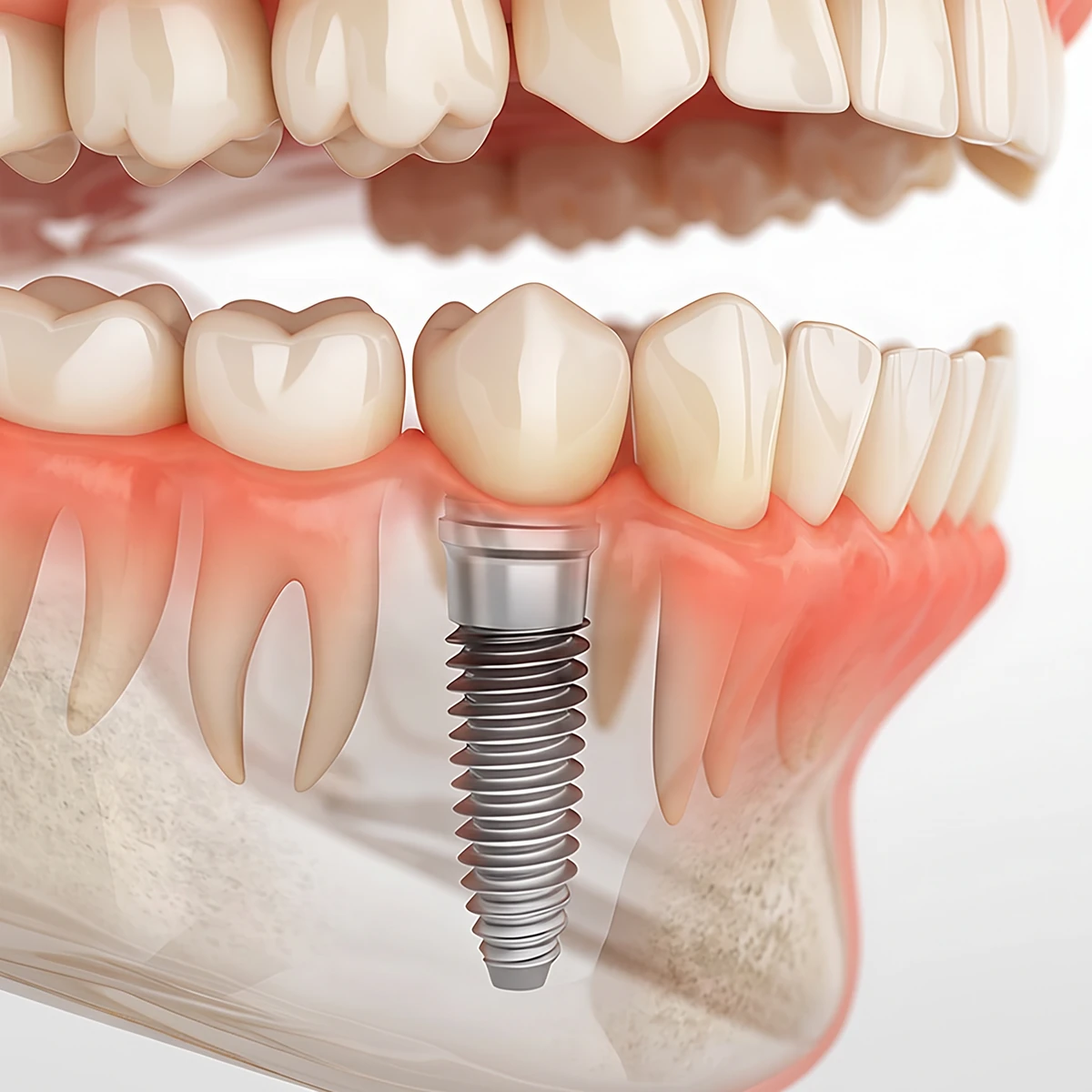
Dental implantology replaces one or more missing teeth with artificial titanium roots, onto which a crown, a bridge or a full arch is fixed. In clinically suitable cases, immediate loading is possible: the implant and a fixed temporary tooth in the same session.
What is dental implantology?
Implantology replaces the roots of natural teeth with biocompatible titanium implants placed in the upper or lower jawbone. Once the implant has integrated with the bone (osseointegration), the new crown is fixed onto it, reproducing the shape and function of a natural tooth without grinding down the neighboring teeth, as a traditional bridge would require. It can replace a single tooth, several teeth or a full arch.
Who are dental implants for?
An implant is indicated when one or more teeth are missing, or when a tooth is compromised and can no longer be saved. A good candidate is someone in good general health, with healthy gums and enough bone — or bone that can be rebuilt — to support the implant. At our clinic we assess every case with a visit, a clinical examination and X-rays, to understand whether implantology is the right solution or whether an alternative would be better.
When an implant is not indicated
In some situations the procedure should be postponed or avoided: untreated periodontitis or infections, insufficient oral hygiene, some uncontrolled systemic diseases, certain medical treatments (in particular some bone medications, such as the bisphosphonates used, for example, to treat osteoporosis, which require a dedicated assessment before implant surgery) or heavy smoking, which reduces the chances of success. Many of these, however, are not permanent obstacles: often, treating them first is enough to make the implant possible. The assessment is always individual.
How it works, from the visit to the implant
The process starts with the visit and X-ray examinations, including a cone beam CT (CBCT) scan, which shows the bone in 3D. With guided surgery we plan the position and angle of each implant on the computer before the procedure: this means greater precision, less invasiveness and shorter treatment times. The implant is placed under local anesthesia, so that the procedure is comfortable.
Immediate loading and All-on-4
When the clinical conditions allow it, we place the implant and a fixed temporary prosthesis in the same session: this is immediate loading. With the All-on-4® technique, in suitable cases, we restore a full arch with four implants, so you can smile and chew again right away while you wait for the final prosthesis.
Even with little bone: subperiosteal and zygomatic implants
In cases of bone atrophy we use advanced solutions: subperiosteal implants with a custom grid (EagleGrid) and zygomatic implants, which are anchored to the cheekbone (zygomatic bone) and avoid or reduce the need for grafts. In other cases the bone is first rebuilt with a graft and the implant is placed afterwards.
Average timelines and healing
After placement, the implant needs a few months to integrate with the bone: generally 3 to 6 months, faster in the lower jaw and longer in the upper jaw, depending on the case. With immediate loading you still have a fixed temporary tooth right away; the final crown or prosthesis is fitted once healing is complete.
Lifespan, risks and maintenance
A well-integrated, well-cared-for implant can last many years. Like any surgical procedure, implantology carries possible risks — swelling, infection and, in rare cases, failure to integrate — which we explain clearly before we begin. To last over time, implants require good daily hygiene and regular professional hygiene checkups, which prevent peri-implantitis, the inflammation of the tissues around the implant.
Alternatives to an implant
An implant is not the only option. Depending on the case, a dental bridge (which, however, requires grinding down the neighboring teeth) or a removable denture, partial or full, may be indicated. Compared with these, an implant has the advantage of being fixed, of not involving healthy teeth and of better preserving the bone over time. During the visit we compare the options together, with the timelines and indications of each.
- Biocompatible titanium implants (WinSix Biosafin)
- Immediate loading and All-on-4 when possible
- Solutions for bone atrophy: subperiosteal, zygomatic, EagleGrid
- Computer-guided 3D planning
- First visit and no-obligation estimate



Frequently asked questions
Is getting an implant painful?
Placement is done under local anesthesia, which means that, as a rule, the procedure does not hurt. In the following days you may feel mild discomfort or swelling, which can be managed with the medication we recommend.
How long does a dental implant last?
A well-integrated implant, maintained with good hygiene and regular checkups, can last many years. How long it lasts depends on the health of the gums and bone and on the patient's habits, such as hygiene and smoking.
Can implants be placed if there isn't enough bone?
Often, yes. When bone is insufficient we use grafts, zygomatic implants or subperiosteal implants with a custom grid. We determine this with a cone beam CT scan during planning.
How long before I get the final tooth?
Osseointegration generally takes 3 to 6 months. With immediate loading, however, in suitable cases you already have a fixed temporary tooth in the same session as the procedure.
Can I get implants if I smoke or have diabetes?
These are factors to evaluate: smoking and uncontrolled diabetes reduce the chances of success, but in many cases an implant is still possible after appropriate preparation. The assessment is always individual.